The Different Types of Feldspar Gemstones
25 October 2026 By Paul Haywood FGA DGA
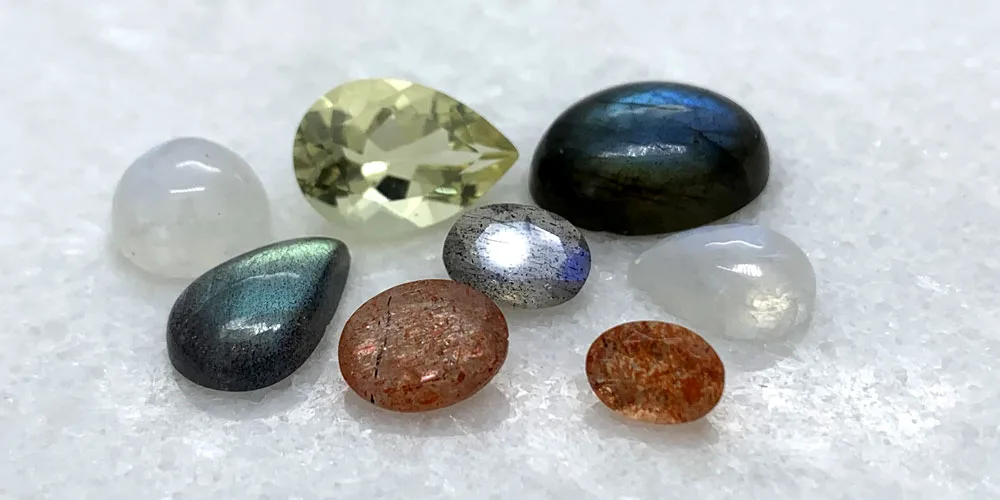
Feldspars are one of the most abundant mineral groups on Earth and there are over 15 different varieties of Feldspar but only 7 are used as gemstones (the other varieties are more important to geologists than gemmologists!).
It is the varieties that are used for gemstones that I am going to look at for this post.
Feldspar Isomorphous Series
Before I get to the different types, I just want to briefly cover the science behind how we categorise Fledspars (If you don’t want to learn about this part, feel free to skip to the next section that looks at the different types of Feldspar gemstones).
Feldspars form as what is known as an isomorphous series, which means that they share the same crystal structure but have slightly different chemical composition. I’ve created the image below to show this:
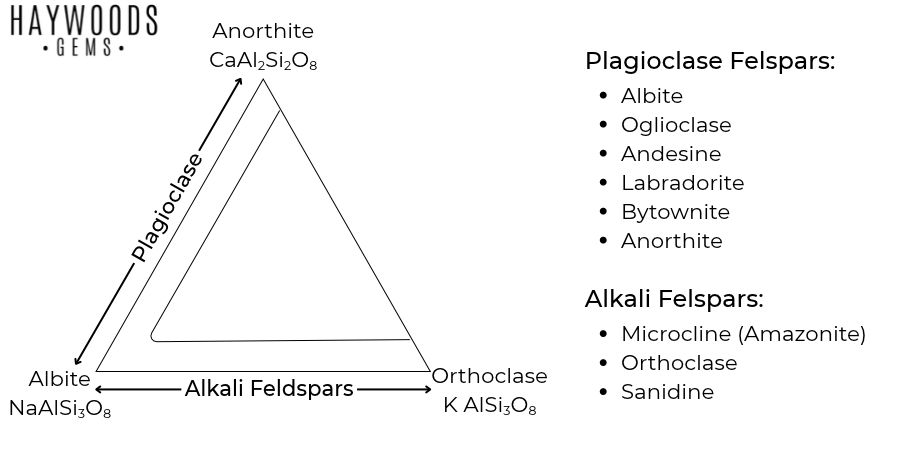
As you move through each series, the chemical composition gradually changes as it moves from one end to the other (the Plagioclase series is listed in order) and creates the different species of Feldspar.
While you may recognise some of the species, most of the more well-known Feldspars are actually varieties of these species and this is what I am going to look at in more detail below.
Feldspar Gemstones
So let’s take a look at the different varieties of Feldspar gemstones.
If they don’t have a picture, it means I don’t have any examples in my personal collection.
Labradorite
Hardness
6
Toughness
Poor
Stability
Good
RI
1.55 – 1.57
SG
2.65 – 2.75
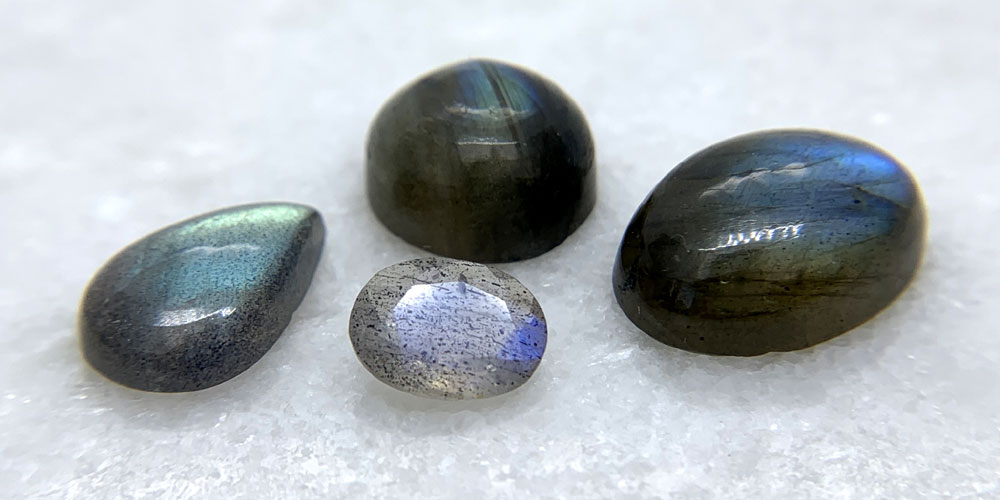
Labradorite is one of the most well-known Feldspar varieties and a relatively popular gemstone.
On the face of it, it doesn’t sound like the most appealing stone, as most of the stones out there are translucent or opaque and have a pale-green base colour (can also be found with blue, colourless or grey-white) but there is something that makes them stand out.
And that is an optical phenomenon known as schiller (sometimes called labradorescence), which causes a beautiful flash of iridescent colours as the stone is moved under a light source and, in some cases, can include a full spectrum of colours.
Named after the region in Canada that was an important early source, it holds an important place with the Intuit people, where local legend says the stone contains frozen rays of the Aurora Borealis and it is easy to see why (this is also one of my favourite gemstone legends).
While very beautiful stones, they are quite brittle and can break easily, so care needs to be taken with them.
Labradorite is used in a number of different ways:
- Gemstones – commonly fashioned as cabochons, sometimes higher-quality material is faceted but this is usually transparent material with a colourless or grey-white base
- Ornamental Pieces – from simple wands to intricate ornate pieces
- Countertops – one of the more unusual, but for the gem lover with a lot of money, really large slabs can be used as countertops
Rainbow Moonstone
Rainbow Moonstone is a little bit misleading as it isn’t actually Moonstone, it is a variety of Labradorite.
And it is easy to see why it is called Moonstone as the stones look more like Moonstone than traditional Labradorite, as they are colourless, transparent stones that show multi-coloured adularescence but they are just really high-quality Labradorite.
The best material comes from Madagascar and unlike Labradorite, they are more commonly cut into faceted gems and has a higher per carat.
Oregon Sunstone
Another stone whose name is a bit misleading is Oregon Sunstone, as it isn’t actually Sunstone but another variety of Labradorite.
While its appearance can be somewhat similar to Sunstone, there are some things that make it stand out:
- Colour Range – can be found in a wider range of colours, including pale yellow, pink, orange, red and green
- Bi and Tri-Colours – rare stones can show two or three colours
- Shiller – some stones show a shiller effect and this is caused by copper inclusions, which is unique to Oregon Sunstone
The name also gives something else away and that is that it is currently only found in Oregon.
Commercial quality stones are relatively inexpensive but top quality examples can sell for over $1,000/ct as they are highly prized by collectors.
Moonstone
Hardness
6
Toughness
Poor
Stability
Good
RI
1.52 – 1.54
SG
2.56 – 2.59
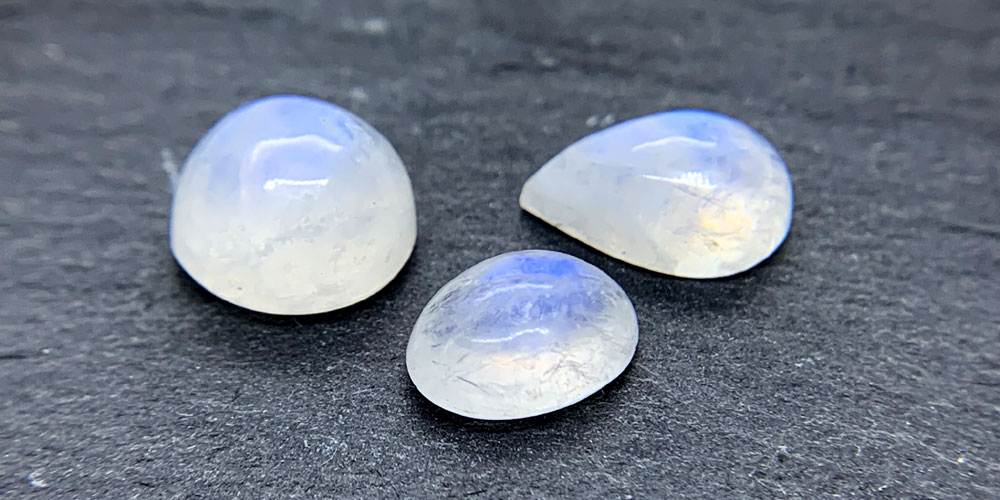
Moonstone is another very popular Feldspar gemstone, which is a variety of Orthoclase.
Even though the white or colourless examples are the most well-known, Moonstone can be found in a number of different colours, including pink, orange and yellow.
Similar to some of the other varieties of Feldspar, Moonstone has its own optical phenomenon, which is known as adularescence (schiller), with many stones displaying a silvery-white to bluish flash of colour when moved under a light source.
Some stones can also be cut in a way that displays chatoyancy (cat’s eye).
- High Quality Material – this material is transparent to translucent and is almost always cut into gemstones, most commonly as cabochons but you may also find faceted Moonstone
- Low Quality Material – usually opaque with a large number of inclusions, used for ornamental pieces, with spheres being a popular choice
The highest quality Moonstone is completely transparent, has no inclusions and shows a really strong shiller effect, this material can sometimes sell for over $100/ct.
Sunstone
Hardness
6
Toughness
Poor
Stability
Good
RI
1.54 – 1.55
SG
2.65 – 2.75
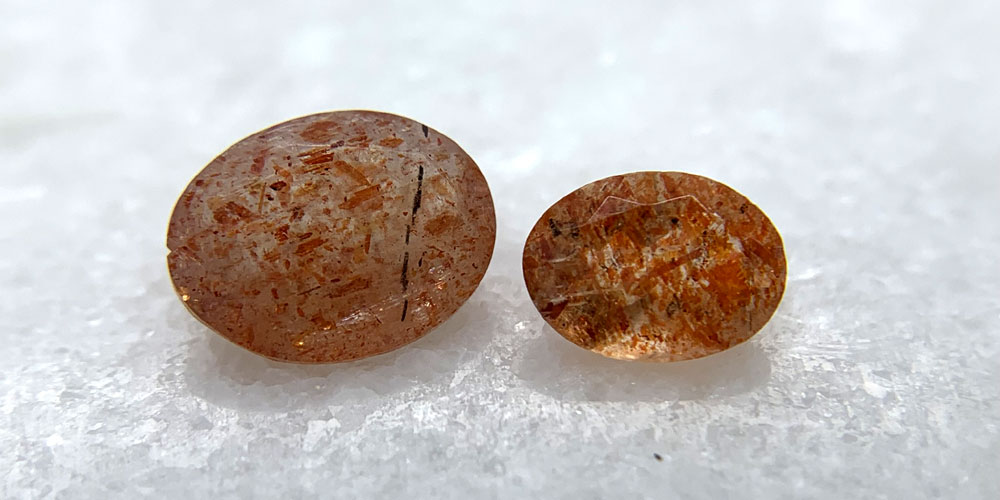
Another well-known variety of Feldspar is Sunstone (it is actually a variety of Oligoclase).
It is usually colourless but can have an orange or brownish hint and like other Feldspar varieties, it is an optical phenomenon that makes Sunstone stand out, it is known as aventurescence, which is a metallic shimmer caused by light reflecting off lots of small inclusions (either goethite or hematite).
These inclusions are also responsible for creating the speckled orangy-red colour that is seen in most sunstone.
Gem-quality Sunstone is transparent to translucent and is most commonly cut into cabochons but it isn’t unusual to come across faceted stones.
Lower-quality material is used for ornamental pieces, with spheres being a popular choice.
Orthoclase
Hardness
6
Toughness
Poor
Stability
Good
RI
1.51 – 1.53
SG
2.54 – 2.61
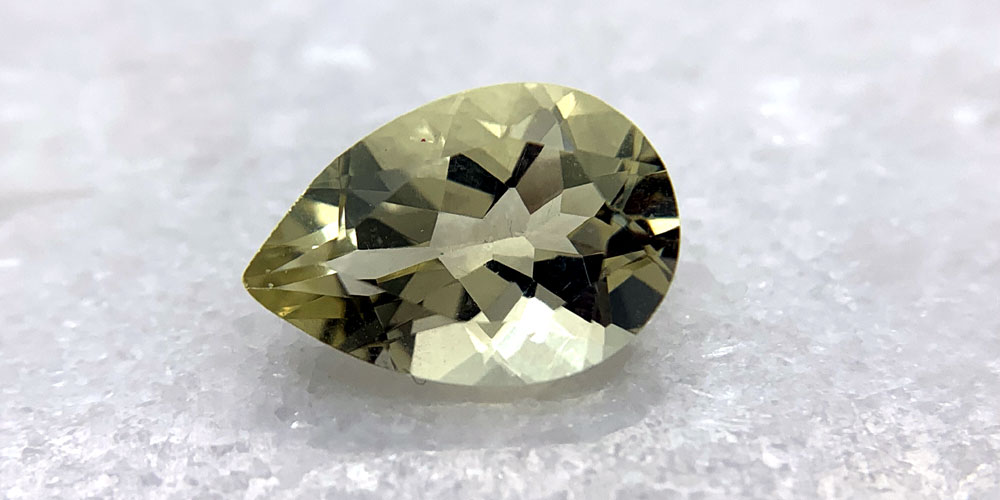
Much of the Orthoclase that is found is low-quality opaque material that is white to greyish-yellow but there is gem-quality material that is somewhat rare.
Gem-quality Orthoclase is transparent and ranges from colourless to yellow, with yellow stones being the most desirable.
They are usually faceted but due to being quite soft and brittle, it is usually more of a collector’s stone.
Its appearance can cause it to be confused with other yellow stones, including Chrysoberyl, Topaz and Citrine (which is what my example was sold), but it can be identified by its low RI and biaxial birefringence.
Amazonite
Hardness
6
Toughness
Poor
Stability
Good
RI
1.52 – 1.53
SG
2.55 – 2.57
Amazonite is a green to green-blue, translucent to opaque variety of Feldspar.
Even though it is named after the Amazon river, it is doubtful whether it actually occurs in the area, with the USA, Russia and the Minas Gerais region of Brazil being some of the biggest producers.
Gem-quality Amazonite is usually cut as cabochons, with faceted stones being rare.