

Are Diamonds Rare? (What The Numbers Say)
22 October 2026 By Paul Haywood FGA DGA
Are Diamonds actually rare?
This is a very commonly asked question and understandably so, as being rare has been part of the marketing around Natural Diamonds.
I wanted to find out myself, so I did some digging, crunched the numbers to see whether Diamonds are rare or not.
Historically
For centuries, Diamonds were very rare, as up until the late 1800s, Diamonds were only mined in two areas.
For over 1,000 years, the Kingdom of Golconda in India was the source of the finest Diamonds and some of the most famous Diamonds in the world, including the Koh-I-Noor, the Dresden Green and the Wittelsbach-Graff.
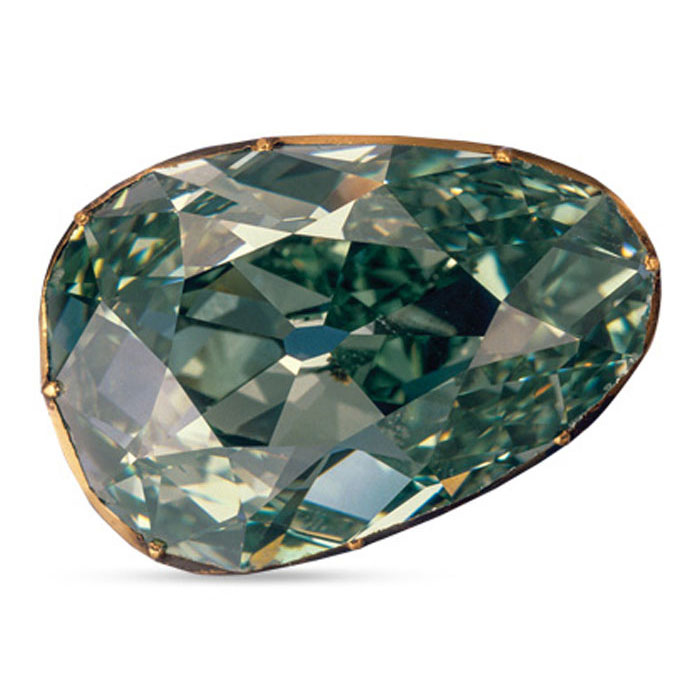
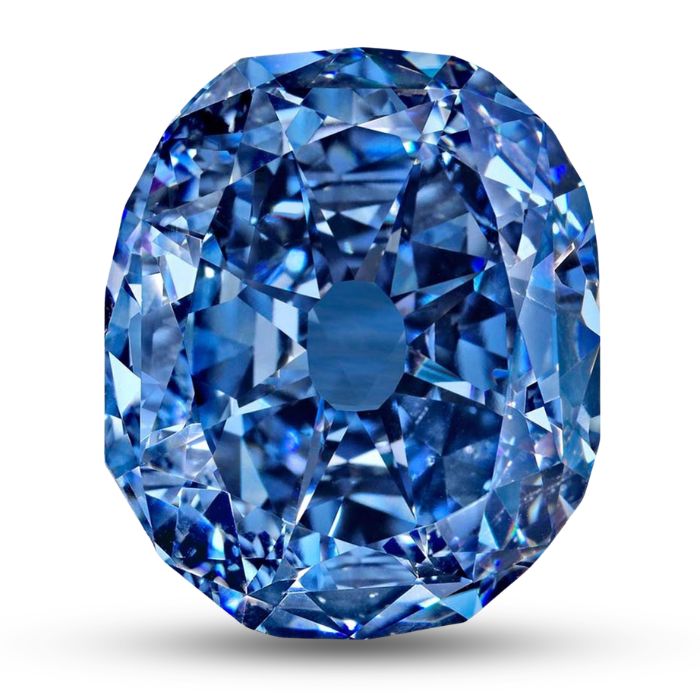
The majority of Diamonds found here were Type IIa, which even in the modern world are rare in nature, with less than 2% of Natural Diamonds being classified as Type IIa.
The next major Diamond discovery was in Brazil in the early 1700s and for the next 150 years, the region of Minas Gerais would be the major supplier of gem Diamonds.
The Golconda and Brazilian sources were alluvial deposits, which only produced a small number but usually higher-quality stones.
This all changed with the discovery of the Eureka Diamonds in South Africa in 1867 as from this Diamond, they were able to find the primary source of Diamonds (in this case, Kimberlite pipes) and Diamonds were being mined in far greater numbers.
Geologically
From a geological perspective, Diamonds are pretty rare and rarer than many other minerals and metals, for some context:
- There are approximately 6,800 known Kimberlite pipes in the world but only around 900 of these contain Diamonds
- Of these approximately 1,000 diamond-bearing Kimberlite pipes, only around 60 have enough Diamonds to be economically viable to mine
- Even within these economically viable pipes, the average concentration of Diamond to rock is around 1 carat per 1 metric tonne
So Diamonds are pretty rare and we can take this a step further:
How Many Diamonds Are Mined Every Year?
Mining output varies from year to year but the chart below shows the number of carats mined every year between 2015 and 2024, according to official Kimberley reports.
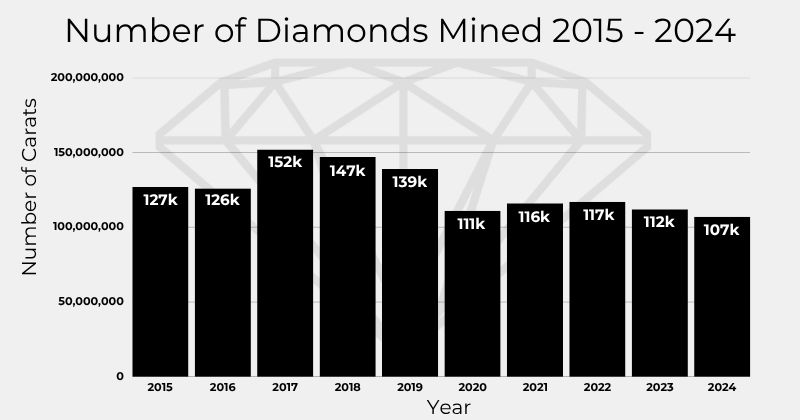
In this 10-year period, the average number of carats mined per year was 125 million.
This sounds like a lot in terms of carats but when you convert that to metric tonnes, the number does sound as big as that averages out to 25 metric tonnes of Diamonds mined every year.
For context, the average semi-truck can haul between 19 and 21 tons, so you could fit all the Diamonds mined each year into two semi-trailers with plenty of room to spare.
How does this compare to other materials?
When it comes to gemstones, we simply don’t know the volume as unlike Diamonds, the volume of material mined isn’t recorded.
The closest thing I could find to compare it to was precious metals:
- Platinum: 170 metric tons
- Gold: 3,000 – 3,500 metric tons
Even Rhodium, which is considered to be one of the rarest metals on earth (it is used to plate White Gold and make it really shiny), averages around 20 metric tons a year (source: Statista).
And even though we are comparing Diamonds to metals here, it still shows that in terms of volume, not that many Diamonds are mined each year.
How Many Diamonds Are Produced Each Year?
The volume of Diamonds that are mined each year only tells half of the story as not all these rough Diamonds go on to become the sparkly, cut and polished diamonds that are set into jewellery.
It is estimated that between 20% and 30% of Diamonds each year are of gem quality, with the rest being used for industrial purposes (usually as abrasives).

There is also the next step in the process, which is the cutting and polishing and the yield from rough stones can range anywhere from 20% – 50%.
Just looking at 2024, where 107 million carats of Diamonds were mine (which was the second lowest production year in the last 20 years), we can calculate that:
Between 21.4 million and 32.1 million carats of rough, gem-quality Diamonds were mined
Between 4.28 million and 16.05 million carats of cut and polished Diamonds
The problem is that we can only estimate the volume of Diamonds produced each year but more importantly, we don’t know how many individual Diamonds are produced each year.
Diamond Weight, Colour and Quality
Not all Diamonds are the same and when it comes to rarity, this definitely matters as some Diamonds are considerably rarer than others.
And this can be seen by just looking at the selection of Diamonds that are available at any one time, for example, I took a quick look at BlueNile’s Round Brilliant selection and found:
- 55,200 of all colour, clarity, cut quality and carat weight
- 35,100 D-G colour, all clarity, cut quality and carat weight
- 26,600 D-G colour, VS2-F clarity, all cut quality and carat weight
- 23,200 D-G colour, VS2-F clarity, Excellent Cut and all carat weights
- 6,200 D-G colour, VS2-F clarity, Excellent Cut and weighing over 1ct
As you can see, every time you increase the quality factor, the number of stones decreases and significantly so when moving the weight to 1ct or more.
Just out of interest, I bumped this up to D colour, Flawless clarity, Excellent Cut and weighing over 1 carat and there were a total of… 67!
I also found this graphic from the Natural Diamond Council that shows:
- The number of 1 carat+ Diamonds mined each year would fit in an excercise ball
- The number of 5 carat+ plus Diamonds mined each year would fit into a basketball
It doesn’t state whether these are rough crystals or cut and polished stones though.
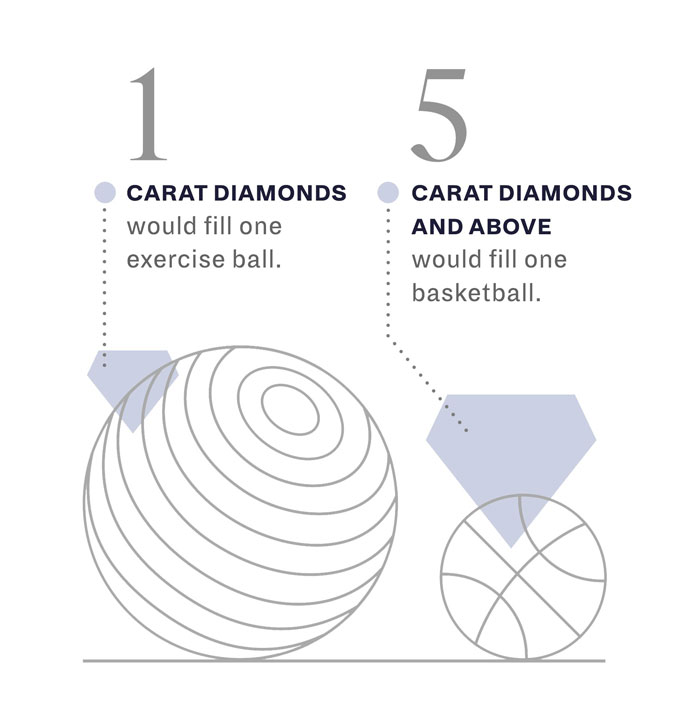
But what this backs up what I saw on BlueNile, the majority of Diamonds that are on sale are smaller and of lower quality.
Fancy Colour Diamonds
I have to talk about coloured diamonds at some point as these are extremely rare and according to the GIA: “Only one out of 10,000 carats of fashioned diamonds displays fancy color” and this drops to one in 25,000 that displays intense colour!
That means that 0.1% of Diamonds mined produced display a fancy colour, with 0.004% displaying fancy colour and using the annual production estiamte I did earlier:
- Between 4,280 and 16,050 carats of Diamonds mined would be classified as a Fancy Colour Diamond
- Between 171 and 642 carats of Diamonds mined would be classified as a Fancy Intense Colour Diamond
And when you consider that some colours are rarer than others, it makes some Fancy Colour Diamonds extremely rare!
So, Are Diamonds Rare?
You may be expecting me to say yes but the reality is that it isn’t a straightforward yes or no.
From a geological perspective, they are pretty rare and there are rare Diamonds such as fancy colours or 10ct+, high quality colourless stones.
But if we think of Diamonds as a whole, I don’t think they are, let me explain.
- We produce millions of cut and polished Diamonds every year
- Millions of people around the world buy Diamonds every year
- It is estimated the 85-90% of engagement rings contain a Diamond
- You can walk into pretty much any jewellers and buy a Diamond
- Go to any jewellery or Diamond quarter/district and you will see hundreds, if not thousands of Diamonds for sale
- Tens, possibly hundreds of millions of people around the world own a Diamond
I’ve included the Cambridge dictionary definition of rare: “not common or frequent; very unusual:“
I don’t know about you but none of the points I listed above really tie into the definition and I think the best way to describe Diamond rarity is:
Diamonds aren’t really rare but there are rare Diamonds.
Sources: