
Ruby Price and Quality Guide (Colour, Clarity & More!)
Why are some Rubies worth millions of dollars and others less than $100?
That is what I am going to answer in this post by looking at the different factors that impact the price of these amazing gemstones.
Ruby Price Factors
Ruby prices can vary massively from less than $50/carat to over $1,000,000/carat due to the large number of factors that affect the price of a Ruby, including:
- Colour
- Clarity
- Style of Cut & Cut Quality
- Weight
- The origin of the stone
- Whether it has been treated
- Whether it is natural or synthetic
- If the stone comes with a lab report
This is why it is nearly impossible to give any kind of guidance on Ruby prices online and prices are determined on a stone-by-stone basis by people who understand the Ruby market.
Let’s take a look at these factors in more detail:
Colour
Colour is one of the most important quality factors when it comes to Ruby prices and when assessing the colour, we look at three main factors:
- Hue – this is the main body colour of the stone and ideally, this will be pure red but Rubies can have secondary tones of orange, blue, purple or pink, which aren’t as desirable
- Tone – this is how light or dark the stone is and Rubies can range from light pinkish red to a very deep maroon colour, with stones falling in the middle of this range being the most desirable
- Saturation – this is the intensity of the colour, with the finest stones having a vivid saturation that gives them that rich, vibrant red that Rubies are known for
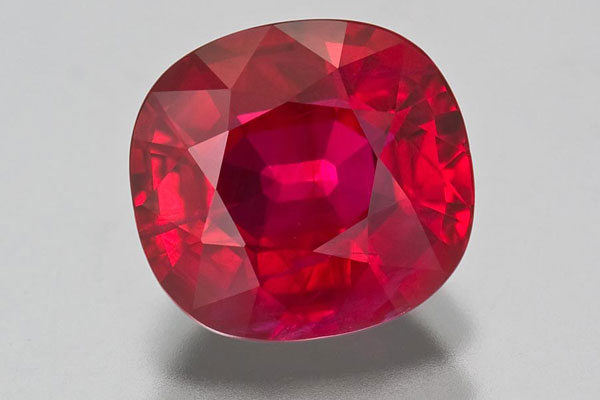
As you can see, there is a lot to consider when it comes to colour quality in Rubies and many people refer to stones with top-quality colour as ‘Pigeon Blood’, although some say this should only be used with Burmese Rubies.
The Graff Ruby (pictured) is one of the finest examples of a ‘Pigeon Blood’ Ruby and the rich, vibrant colour is what most people think of when they picture a Ruby.
But this colouration is extremely rare in natural, untreated Rubies.

Clarity
Another very important quality factor is the clarity of the stone as this has a big impact on the beauty and, in some cases, the durability of the stone.
When it comes to assessing the clarity, there are a few things to consider:
- Visibility – how easy/difficult is it to spot the inclusions and this is where you will hear terms like:
- Eye Clean – meaning the inclusions are difficult to see with the naked eye
- Loupe Clean – meaning that inclusions are difficult to spot with a 10x loupe
- Nature – this is the type of inclusions, for example, a large fracture has a bigger impact than a small crystal inclusion
- Transparency – is the stone transparent, translucent or opaque?
In general, Rubies are more likely to have inclusions than Sapphires, which is why ‘clean’ stones do fetch a premium.
But inclusions can be useful as they can be used to identify the origin of the stone and whether or not the stone has been treated.
The Exception – Star Rubies
On paper, they don’t look very appealing as they are opaque and heavily included, the colour also isn’t usually the best but…
These stone possess a phenomenon called asterism, which is where light reflects off rutile inclusions that form parallel to the natural crystal faces and produce a 6 rayed star when looked at, such as the one in the picture.

Star Rubies with good colour and a clearly defined star are highly desired by collectors and can be quite valuable.
Rubies Are NOT Clarity Graded
Unlike Diamonds, Rubies are not clarity graded by gemmologists or gem labs, so be aware of anyone selling a Ruby who is using Diamond clarity grades such as SI or VVS to describe the clarity of a Ruby.
Cut
The next quality factor is cut and there are two parts, which are the style of the cut and the quality of cut.
Style of Cut
The style of cut doesn’t have an impact on the quality of the stone but it does impact the price as some styles of cut are more popular than others, with the more popular cut styles often having a higher price per carat than an equivalent quality stone in an undesirable cut.
When it comes to the most popular styles of cut, the majority of natural Rubies are cut as one of the following:


And there are two main reasons why these styles of cut are popular:
- They are timeless styles and rarely go out of fashion
- They help bring out the colour in the stone
From a cutters perspective, these styles often produce a good yield from the rough crystal and when Rubies are sold on a price per carat basis, this is very important.
Smaller Rubies may be cut into squares or marquise cuts but larger stones are usually one of the three listed above unless a certain style of cut has been requested by a client.
Quality of Cut
While the style of cut does play a part in the value of the stone, the quality of the cut is more important as it can be the difference between the stone looking amazing or dull and lifeless.
But most Rubies are cut as a compromise between optimising the colour and beauty of the stone and retaining weight as generally, the heavier the stone, the more it costs.
When it comes to the quality of the cut, there are some things that determine whether it has been cut well or poorly, these include:
- Proportions – have the crown and/or pavilion been cut too shallow or deep
- Facets – are they properly aligned and have crisp edges
- Table – is the table in the centre of the stone
- Girdle – is a straight and even or wonky
- Polish – are there polishing lines of the facet faces

For top quality stones, they are usually cut to a very high standard and these things aren’t an issue but as the price per carat starts to drop, usually, the quality of the cut does as well.
Carat
While carat weight isn’t a quality factor, it is definitely a price factor.
And the jump in the price per carat between larger and smaller stones of the same quality can be very significant (more so than many other gemstones), with there being significant jumps in the price per carat when the carat weight passes certain ‘milestones’ such as 1 or 2 carats.
This becomes even more noticeable with stones weighing more than 5 or 10 carats.
The reason for this comes down to geology, as large Ruby crystals with good colour and clarity are rare.
Treatments
Rubies with good colour and clarity are very rare in nature, with these stones attract a premium and there are not enough of these stones found to satisfy the demand in the marketplace.
This is why the majority (over 90%) of Rubies for sale at any one time have been treated in one way or another and there are a number of different ways that Rubies can be treated, all of which have an impact on the value of the stone, the three most common Ruby treatments are:
Heat Treatment
By far the most common treatment method is heat treatment, the outcome of heat treatment depends on the stone but results can include:
- Making stones lighter or darker
- Altering the colour slightly
- Removing undesirable hues or colour zoning
- Improving clarity
Heat treatment replicates what happens to stones in nature and the results are permanent.
It is an industry-accepted treatment and is rarely disclosed, as it is assumed that the stone has been heat-treated.
Sellers will explicitly state if a Ruby hasn’t been heat-treated but should always have a report from a reputable lab to confirm this.
Heat-Treated Rubies – these sell for less than their untreated counterparts and as the majority of Rubies on the market have been heat-treated, a lot of pricing is based around heat-treated stones
Heat Treatment + Flux
A modification of the traditional heat treatment is to add a flux (usually borax) to the process.
The result of this treatment is that can help to partially ‘heal’ surface-reaching fractures by melting and recrystallizing the surface of the fracture, which makes them less noticeable.
As with standard heat treatment, the results are permanent but it should always be disclosed.
Heat + Flux Rubies – these sell for less than Rubies that have just been heat treated due to the additional treatment that has taken place
Glass Filling
Glass-filling is done to very low-quality material with the goal of filling the fractures with lead-glass (which has a similar RI to Ruby), which reduces the appearance of fractures, making them more attractive to look at.
The process of glass-filling involves heating the stone in the presence of lead-glass powder, which melts and fills the fractures.
Glass filling isn’t a permanent treatment and can easily be removed from the stone (such as being exposed to the heat of a jeweller’s flame) and should always be disclosed.
Glass-filled Rubies – these ‘Rubies’ (some are more glass than Rubies) often sell for less than $50/carat as they are very low-quality and honestly should be avoided

Natural vs Synthetic (Lab-Grown) Rubies
Whether a Ruby is natural or synthetic can have a huge impact on the price of the stone, especially if they are of similar quality.
For example, the synthetic Ruby in the image above can be bought for less than $10/carat but a natural of the same size and quality would easily be over $1000/carat and could be over $10,000/carat if it hasn’t been treated.
If the stone is being sold as a Ruby, then it is assumed that the stone is natural as all synthetic stones state that is synthetic, man-made or lab-created so that you as the buyer know that it isn’t a natural Ruby.
Origin
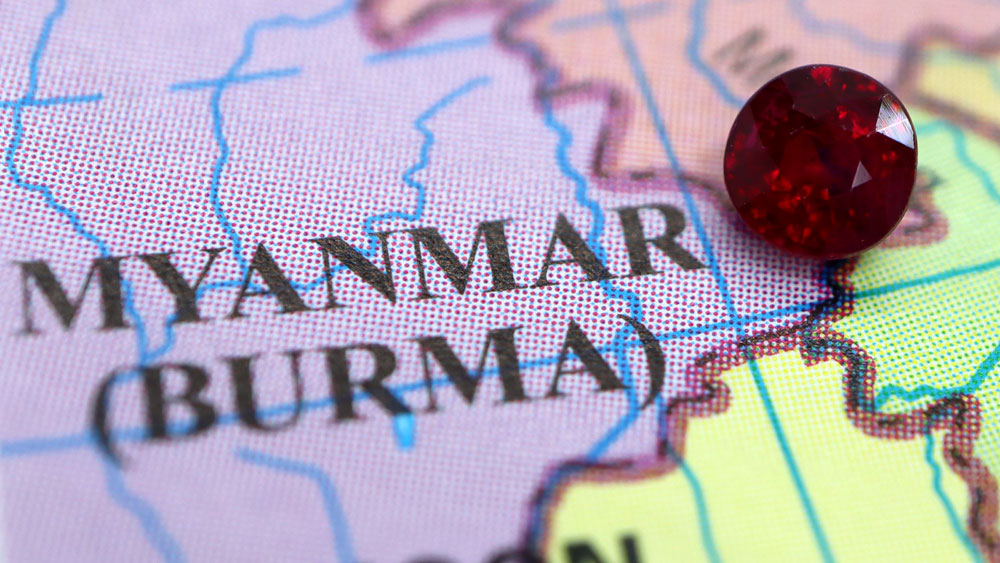
Origin can play a big factor in a Rubies value as some locations are more desirable than others and this can have a big impact on the price of a stone, even if the stones are of similar quality.
The most desirable locations for Rubies are:
- Myanmar (Burma) – the most famous and desirable location for Rubies, especially ones from the Mogok region and they are always called Burmese Rubies after the country’s previous name and many believe the best Rubies and ones with the true ‘Pigeon Blood’ colour come from here
- Mozambique – now the largest Ruby producing country in the world and it terms of quality, many believe that they rival those from Burma
- Thailand – historically a very important Ruby producing country and prior to the discovery of Rubies in Mozambique, Thai Rubies were only behind Burmese in terms of desirability and demand
Rubies are found in many other locations around the world, including Sri Lanka and Madagascar but they are not as desirable as stones from the countries listed above.
Thailand is an interesting one as not only have Rubies been mined there for over 100 years but they are also the leading cutting and trading centre for Rubies and many of the world’s Rubies will probably have passed through there at some point.
Lab Reports
Lab Reports are an important document but not every Ruby will be sold with a report as unlike Diamond reports, they don’t give any information about the quality of the stone but they do include some very useful information, which can include:
- The stone, size, weight etc
- The identity of the stone
- Whether the stone is natural or synthetic
- If the stone has been treated or not
- The origin of the stone (it is not possible to do this on some stones)
And a report from a reputable gem lab, such as the GIA, Gubelin, SSEF, IGI or Anchorcert is essential if the seller is claiming that the Ruby is untreated and from a specific location.
Reputable Gem Labs ONLY Produce Reports
And they explicitly state this on the document/card that accompanies the stone, if the document or card says ‘certificate’ or ‘certificate of authenticity’, run away from it as fast as you can as the stone might not even be a Ruby.
Ruby Gemstone FAQ
How Can You Tell A Good Quality Ruby?
A good quality Ruby will possess a combination of a rich red colour, good clarity (eye clean with minimal inclusions) and good cut quality.
What is the Most Valuable Colour of Ruby?
The most valuable colour of Rubies is know as ‘Pigeon Blood’, this is a pure red colour and is especially prized in Mogok Rubies from Burma. Rubies with a slight purplish tint are valuable but less so than pure red. Stones with a strong purple or orange overtone are less valuable.
What is the Price of Ruby per carat?
Rubies vary in cost per carat and it all depends on the quality of the stone but it can range anywhere from less than $100/ carat to over $1 million/carat.
What is the Best Cut for a Ruby?
The most popular cuts for Rubies are Oval and Cushion as they produce the best yield from the rough crystals. With smaller stones (less than 1ct), Round, Square and Pear are also popular options.
What is the difference between a Ruby and Pink Sapphire?
There isn’t a defined point where a stone goes from a Pink Sapphire to a Ruby, it is all down to individual interpretation of the colour of the stone.
Conclusion
As you can see, there are a lot of factors that affect the price of a Ruby, with some having a very significant impact.
A lot of people will ask “What is the most important thing to look for in a Ruby?” and I don’t think there is one thing that stands out from the rest as you need to look at and assess all the factors to get a true picture of the stone.
Other articles from The Gem Guide series:


I'm Paul Haywood FGA DGA, the owner and founder of Haywoods Gems, I'm a fully qualified Gemmologist and Diamond Grader from the Gemmological Association of Great Britain.